Chapter 11: Royal Dutch Shell and Nazi slave labour
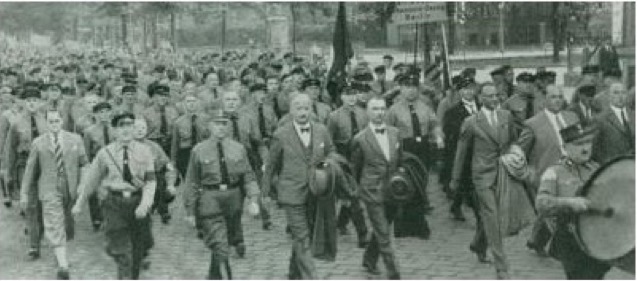
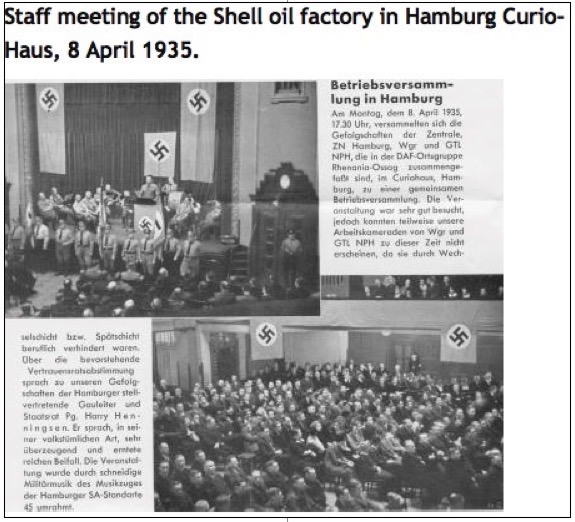
In 1935, Rhenania-Ossag, owned by Royal Dutch Shell, was Germany’s second-largest gas station company, with 16,363 petrol pumps and several refineries.253 There were active Nazi members in both the workforce and the management. Shell’s own historians later wrote that Rhenania-Ossag “quickly adapted to the New Order” and that, when the test came, market position and managerial habit won the day.254 Other evidence points in the same direction. A German article about Robert Finn, a Shell employee who later headed Germany’s lubricating-oil supply during the war and returned to Shell as a director afterwards, includes photographs from Shell staff meetings in 1935 held under swastika banners and from a 1 May 1938 march of Rhenania-Ossag employees, some in uniform.255 299
As discussed in Chapter 6, Rhenania-Ossag had already adopted anti-Semitic policies in 1933. More seriously, there is evidence from a credible source that Rhenania-Ossag used Jewish forced labour in June 1939, several months before a Verwalter was appointed by the Nazis to oversee the company in January 1940. Forced labour had been used by the Nazi regime from as early as 1937. Extract from the United States Holocaust Memorial Museum website:256 Even before the war began, the Nazis imposed forced labor on Jewish civilians, both inside and outside concentration camps. As early as 1937, the Nazis increasingly exploited the forced labor of so-called “enemies of the state” for economic gain and to meet desperate labor shortages. The evidence in relation to Rhenania-Ossag comes in part from the testimony of Fritz Sarne, a Holocaust survivor, preserved in German-language online articles. I have provided Google translations into English.257 302 Extract: “Forced labor: As of 6 June 1939 I was hired by Hamburg employment office for work, the Jews used as forced labor. Funnily enough, I am back to Harburg, for Rhenania/Ossag where I have a ‘Jew Column,’ consisting of 50 people who have never done earth works, made levelling work for new tank systems on the grounds of Rhenania/Ossag.” According to his testimony, Fritz Sarne, who died in his mid-nineties in the USA, was subsequently a slave labourer at I.G. Farben and survived to attend the I.G. Farben war crimes trial at Nuremberg as a witness. His grandson contacted me in April 2013. There is evidence from news reports based on declassified U.S. intelligence records that Royal Dutch Shell used slave labour supplied by the Nazis. The Los Angeles Times published, on 22 September 2000, an article under the headline “The Secret (Insurance) Agent Men”:258 Extract: A WWII unit gathered underwriters’ data, such as bomb plant blueprints, from warring nations, declassified U.S. files show. The documents also said that two New York insurance executives, Cecil Stewart and Stewart Hopps, also came under scrutiny for selling war insurance to strategic U.S. industries and reselling some of the risk to Latin American affiliates linked to Nazi insurers. The men also ran a steamship company that chartered tankers for Royal Dutch Shell, a Nazi collaborator that used Hitler’s slave laborers. A similar report appeared in a Boston Globe article, “Cloaked Business,” dated 19 November 2001:259 Extract: Newly declassified United States intelligence records reveal in unprecedented detail how US and Allied firms systematically used backwater countries to conduct backroom business with Axis enterprises. The files peel away a whole new layer of collaboration, describing scores of so-called “shadow agreements” in which corporations disguised their ties with the enemy through the cover of other companies in neutral countries, from Spain to Sweden to much of Latin America. The report said the two men also ran a steamship company that chartered tankers for Royal Dutch Shell, a Nazi collaborator that used Hitler’s slave laborers.
Slave Labour at Shell’s German and Austrian Subsidiaries
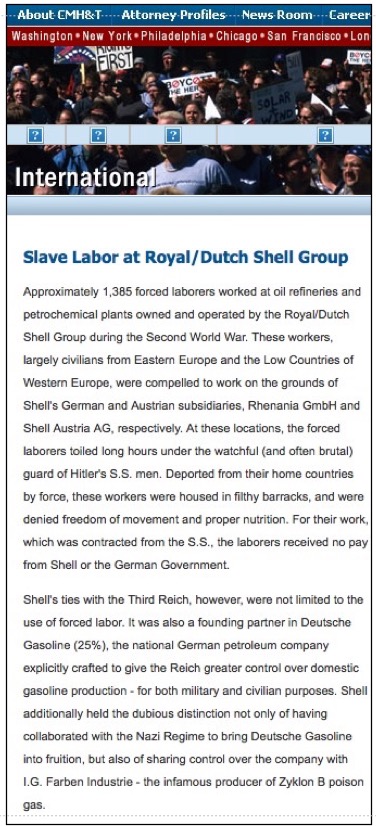
Class Action Statement (with graphics) by U.S. law firm Cohen, Milstein, Hausfeld & Toll P.L.L.C.:260 Approximately 1,385 forced laborers worked at oil refineries and petrochemical plants owned and operated by the Royal Dutch/Shell Group during the Second World War. These workers, largely civilians from Eastern Europe and the Low Countries of Western Europe, were compelled to work on the grounds of Shell’s German and Austrian subsidiaries, Rhenania GmbH and Shell Austria AG, respectively. At these locations, the forced laborers toiled long hours under the watchful (and often brutal) guard of Hitler’s S.S. men. Deported from their home countries by force, these workers were housed in filthy barracks, and were denied freedom of movement and proper nutrition. For their work, which was contracted from the S.S., the laborers received no pay from Shell or the German Government. Shell’s ties with the Third Reich, however, were not limited to the use of forced labor. It was also a founding partner in Deutsche Gasoline (25%), the national German petroleum company explicitly crafted to give the Reich greater control over domestic gasoline production – for both military and civilian purposes. Shell additionally held the dubious distinction not only of having collaborated with the Nazi Regime to bring Deutsche Gasoline into fruition, but also of sharing control over the company with I.G. Farben Industrie – the infamous producer of Zyklon B poison gas. Despite its enormous wealth – as quantified by annual sales in excess of $93 billion – Shell has failed to compensate any of the men and women who worked on its grounds between 1943 and 1945. Detailed information follows on the history of Shell’s German and Austrian subsidiaries, which aided the Nazi effort during WWII, and of the forced labor that was utilized in their operations.: Benzinwerke Rhenania, G.m.b. H Company information: In 1902, the Royal Dutch Oil Company established the Benzinwerke Rhenania, G.m.b. H (Rhenania), as its “daughter company.” Rhenania, which operated oil refineries in and around Hamburg, produced gasoline for consumption in Germany and the Netherlands. In 1924, it entered the gas station business and by 1929 it operated 149 such stations. During WWII, Rhenania produced fuel for the German army, for the air force, and for civilian consumption – until much of its production capacity was destroyed by Allied bombing. Following WWII, the firm’s name was changed to Deutsche-Shell, which is now one of Germany’s largest oil refining corporations (in addition to its interests in chemical synthesis). Slave Labor Information: Approximately 1135 men and women labored on the grounds of Rhenania’s oil refineries and petrochemical factories in northwestern Germany. 150 forced laborers worked at the Hamburg refinery between 1944 and 1945. They were housed at the nearby Concentration Camp Hamburg-Hafen and worked under S.S. guard cleaning debris from air raids, shoveling snow, felling trees, and performing maintenance work. Ms. Zach, a claimant in our registry, was one of the forced laborers who worked for Rhenania in Hamburg. She has attested to the long hours, poor diet, and physical strain she endured during her time with Rhenania. Additional locations which housed Rhenania forced laborers: Civilian Work Camp, Homberg, 420 persons; Civilian Work Camp, Hamburg, 175 persons; Concentration Camp, Schwelm, 380 persons. Sources: Das Nationalsozialistische Lagersystem, pp. 78-9, 410, 434, 482. Shell Austria, AG Company Information: Shell Austria has been a full subsidiary of the Royal Dutch/Shell group since its inception in 1923. Its business has consisted chiefly of refining crude oil to produce gasoline, petrochemical products and fuel oil. It also runs a chain of retail gasoline stations. Slave Labor Information: Between June 1944 and April 1945 approximately 250 forced laborers worked at the Shell oil refinery in Vienna, Austria. The nature of work performed was maintenance and construction. The laborers, exclusively civilians of East European extraction, were interned at the Civilian Work Camp Florisdorf, which was run by Hitler’s Reichsfuehrer-S.S. Sources: Verzeichnis der Haftstatten unter dem Reichsfuhrer-S.S., p. 374. Aggregate Shell Statistics: The litigation apparently did not progress beyond an initial statement, possibly because of a lack of witnesses. Most of the people forced to work for Rhenania-Ossag would not have survived the Holocaust. Any who did survive would have been unlikely still to be alive in 2004. I requested an update on the case from the law firm in October 2012, but did not receive a response. There would certainly be issues over who was responsible: Shell, or an administrator appointed by the Nazi government.
Women Used as Slave Labour
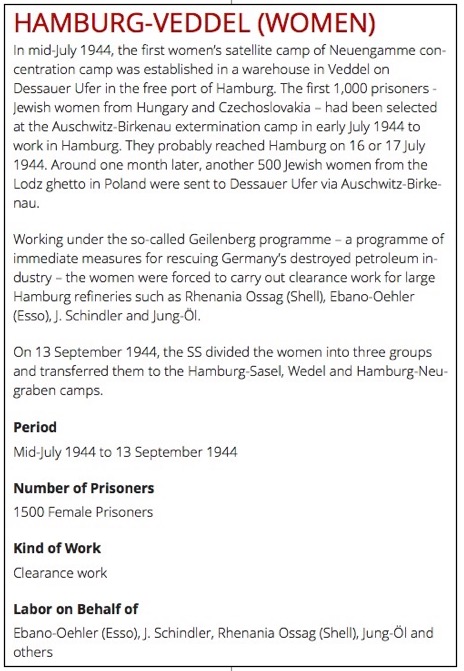
The documentary record confirms that “women labored on the grounds of Rhenania’s oil refineries and petrochemical factories”. Extract from the official memorial website261 for the Neuengamme concentration camp based in Hamburg, the largest concentration camp in northwest Germany:262 In mid-July 1944, the first women’s satellite camp of Neuengamme concentration camp was established in a warehouse in Veddel on Dessauer Ufer in the free port of Hamburg. The first 1,000 prisoners, Jewish women from Hungary and Czechoslovakia, had been selected at the Auschwitz-Birkenau extermination camp in early July 1944 to work in Hamburg. They probably reached Hamburg on 16 or 17 July 1944. Around one month later, another 500 Jewish women from the Lodz ghetto in Poland were sent to Dessauer Ufer via Auschwitz-Birkenau. Working under the so-called Geilenberg programme, a programme of immediate measures for rescuing Germany’s destroyed petroleum industry, the women were forced to carry out clearance work for large Hamburg refineries such as Rhenania Ossag (Shell), Ebano-Oehler (Esso), J. Schindler and Jung-Öl. On 13 September 1944, the SS divided the women into three groups and transferred them to the Hamburg-Sasel, Wedel and Hamburg-Neugraben camps. Period: Mid-July 1944 to 13 September 1944 Number of prisoners: 1,500 women Kind of work: Clearance work Slave labour on behalf of: Ebano-Oehler (Esso), J. Schindler, Rhenania Ossag (Shell), Jung-Öl and others According to the website: “At least 42,900 people died in Neuengamme, its satellite camps and during the camp evacuations at the end of the war.”
Slave Labour at Hydrierwerke Politz
I have already provided some information about Shell’s involvement in the Hydrierwerke Politz project, with its partners Standard Oil of New Jersey and I.G. Farben. During the war, Politz came to rely on large numbers of forced laborers housed in nine camps, which included a separate barracks from the Stutthof concentration camp. The Pommernlager forced labour camp for Poles and prisoners of war existed on the Politz premises from 1940. One commonly cited figure is that 30,000 forced labourers worked at Politz263 during the war. Some 13,000 died of starvation, hard labor, disease, lack of medical care, or outright killing. Shell’s historians cite the same death toll. Extract from page 474, chapter 7, of “A History of Royal Dutch Shell Volume 1”: During the war, Politz came to rely on large numbers of forced labourers housed in nine camps, which included a separate barracks from the Stutthof concentration camp. Thirteen thousand prisoners are said to have died there. However, by that time the Group had lost all control over Rhenania-Ossag and the Politz works… So there is no dispute that slave labour was used at companies wholly or partly owned by Royal Dutch Shell. Shell’s historians argue that by the time this happened the Group had “lost all control”. This crucial question is dealt with in the next chapter. As will be seen, the answer is far from straightforward. Whatever the later arguments over formal control, the use of forced labour at Rhenania-Ossag before the appointment of a Verwalter remains part of the historical record and cannot be brushed aside. Shell has also been accused of involvement in slave labour in South Africa and Brazil: “Royal Dutch Shell and slave labor”264
Notes
253. Link to Google translated Wikipedia article Rhenaniastraße-Ossag (Rhenania-Ossag) ↩
254. Extract from page 493 of “A History of Royal Dutch Shell: Volume 1” ↩
255. Link to a shellnews.net webpage containing a Google Translate article from a “blogger.de webpage posting on Sunday, 8 October 2006, with the sub-heading: “Robert Finn, lubricating oil in the Nazi economy…:” Scroll down to page 28 of 34. Updated article in German. ↩
256. Link to the United Stated Holocaust Memorial Museum website ↩
257. Link royaldutchshellplc.com webpage containing Google Translation article about Fritz Sarne downloaded 30 October 2012 ↩
258. Link to Los Angeles Times article published on 22 September 2000 under the headline: “The Secret (Insurance) Agent Men” ↩
259. Link to shellnews.net webpage containing a boston.com article by Mark Fritz published 19 November 2001 under the headline “CLOAKED BUSINESS” ↩
260. Link to shellnews.net webpage containing text and graphics from a class action statement published by US law rm COHEN, MILSTEIN, HAUSFIELD & TOLL P.L.L.C on 10 May 2004. Original can be viewed on WayBackMachine Internet archive webpage ↩
261. Link to KZ-Gedenkstätte Neuengamme concentration camp website containing information about woman forced to work at Rhenania Ossag (Shell) re nery. ↩
262. Link to Wikipedia article Neuengamme concentration camp, a German concentration camp established in 1938 by the SS ↩
263. Link to Google translation of a Wikipedia article “Synthetic fuel factory in Police” ↩
264. Link to royaldutchshellplc.com article “Royal Dutch Shell and slave labor” Source 1 ↩