Chapter 6: Royal Dutch Shell Anti-Semitism
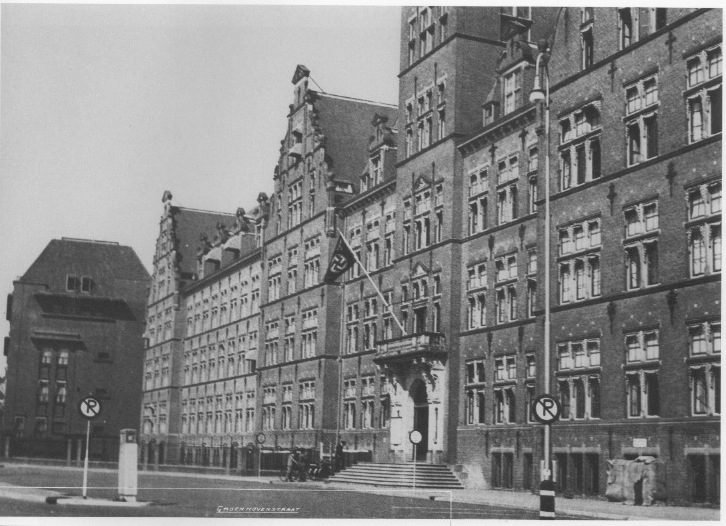
As Deterding’s sympathy for the Nazis became more explicit, he began making strongly anti-Semitic remarks in his correspondence.108 As we will see, Royal Dutch Shell adopted anti-Semitic policies in Germany and later in the Netherlands after occupation by the Nazis. A photograph109 shows the swastika flag flying at the head office of Royal Dutch Petroleum, 30 Carel van Bylandtlaan, The Hague, during the Nazi occupation of the Netherlands in World War II.
On 3 April 1933, the Nazi representatives of Rhenania-Ossag’s works council presented management with demands for the dismissal of all Jewish directors. At the time, outbreaks of violence against Jews had already started in Germany, together with demands for a national boycott of Jewish businesses. Although initially trying to downplay the seriousness of events, Rhenania-Ossag managers decided that it would be wise to align the company speedily with the policies of the Nazi regime. Jewish directors were replaced, in one instance with a member of the Nazi Party. In at least one case, a Jewish director’s resignation was not voluntary.110 Extracts from page 469 of “A History of Royal Dutch Shell” Vol 1: “In retrospect the remodelling of the senior management to suit the New Order would appear to have happened with undue haste…” “The far-reaching changes to the Rhenania-Ossag board could not have taken place without the full consent of Central Offices” “No questions of principle or moral judgements about the Hitler regime appear to have arisen and it bears pointing out that, whereas correspondence shows Group managers quick to identify and condemn Bolshevism, they appear not to have had the same sensitivity to Fascism or Nazism. This blind spot, quite a common affliction in the 1930s, may have impaired their vision when it came to perceiving the intentions of the unfolding Third Reich and the horrendous threat hanging over the Jewish employees in the Group’s care. We do not know the Group’s treatment of the staff members concerned, nor their fates.”111
Following the Nazi invasion of the Netherlands, Hauptmann Eichardt von Klass, the former research director of Rhenania-Ossag, was appointed in January 1940 as Verwalter to administer Royal Dutch and another company within the Royal Dutch Shell Group, Bataafsche. He is said to have forced Bataafsche to comply with the Nazis’ anti-Semitic policy.112 There were, in any event, Nazi sympathizers113 within the company. After the war, Royal Dutch dismissed fifty employees for collaboration with the Germans.114 Extracts: “In October 1941, the German authorities in the Netherlands issued a decree for the dismissal of Jewish employees from private companies. Philips set up a special department for its Jewish employees in December, hoping to keep them out of harm’s way by offering them work under the company’s protection. Bataafsche responded rather more slowly, in February 1942 sending a circular to its Dutch offices instructing them to have the staff complete an Arierverklaring, a form giving particulars about their descent. This survey resulted in forty people being classified as Jewish under the German laws. At least twenty of them did not survive the war.”115 For everything he did, von Klass remained heavily dependent on a handful of Bataafsche middle managers who sympathized with the Nazis….116 The result is stark: a Royal Dutch Shell group company instructed its own employees to declare personal information which, for some, exposed them directly to lethal persecution. As the source itself admits, at least twenty did not survive the war.
The record indicates that anti-Semitism existed within the Royal Dutch Shell Group at that time and was not confined to Henri Deterding alone. For the purposes of this book, the important point is the historical one: anti-Semitic conduct was not merely an external Nazi pressure imposed on Shell from outside. The record shows that Shell managers accommodated it, implemented it, and in some cases acted with alarming speed. That is the proper historical context for judging the company’s conduct in the 1930s and during the occupation years.
Notes
108. From page 481 “A History of Royal Dutch Shell Volume 1.” ↩
109. Link to royaldutchshellgroup.com webpage showing photograph of the Swastika flag flying on the classic Dutch facade of the head office of Royal Dutch Petroleum, 30 Carel van Bylandtlaan, The Hague, during the Nazi occupation of the in World War II (Image From Database Hague Municipal) ↩
110. Information from page 469 of “A History of Royal Dutch Shell: Volume 1” ↩
111. Information from page 469 of “A History of Royal Dutch Shell: Volume 1” ↩
112. Information from page 82 of “A History of Royal Dutch Shell: Volume 2” ↩
113. Information from page 32 of “A History of Royal Dutch Shell: Volume 2” (Nazi sympathizers) ↩
114. Information from page 82 of “A History of Royal Dutch Shell: Volume 2” (collaboration) ↩
115. Information from page 84 of “A History of Royal Dutch Shell: Volume 2” ↩
116. Information from page 86 of “A History of Royal Dutch Shell: Volume 2” ↩